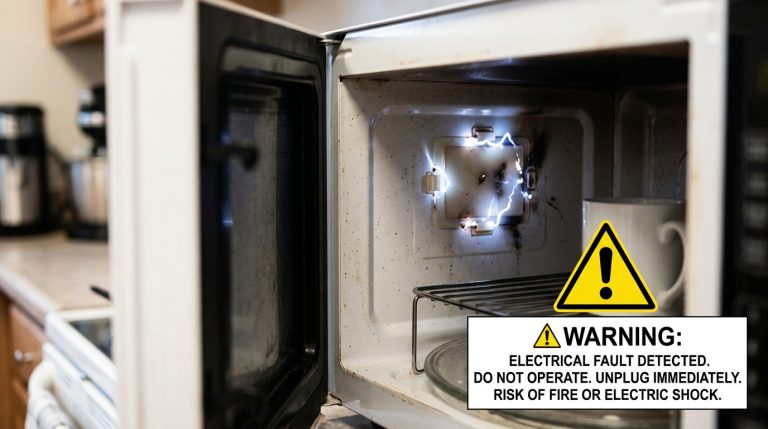
Safety first: Stop immediately if you smell burning plastic, see scorch marks on the outlet, or the breaker trips again the moment you reset it. Leave the breaker off, unplug the refrigerator only if the plug is dry and easy to reach, and call a licensed electrician or appliance technician.
A fridge keeps tripping breaker problem usually has one of three causes:
- An overloaded or faulty circuit
- Moisture or a failed defrost heater causing a ground fault
- A failing compressor or start relay drawing too much current
Reset the breaker once. If it trips again, leave it off and have the circuit or the refrigerator inspected.
A refrigerator should run quietly in the background around the clock. When it suddenly cuts power to part of your kitchen, your electrical system is warning you about something. The fridge is either drawing more current than it should or leaking current where it shouldn’t.
This guide explains what causes a fridge keeps tripping breaker situation, what you can safely check, and when to bring in experienced fridge repair in Tucson.
Why a Breaker Trips in the First Place
A circuit breaker is a safety device, and different types trip for different reasons:
- Standard breaker: trips when the current on a circuit exceeds its rating (an overload) or when a short circuit causes a sudden surge.
- GFCI: a ground fault circuit interrupter, found as an outlet or a breaker. It trips when it detects even a small amount of current leaking to ground, such as through moisture or damaged insulation.
- AFCI: an arc fault breaker. It trips when it detects arcing in the wiring.
Each type points to a different kind of problem, so notice which device is actually tripping.
Common Causes of a Fridge keeps Tripping the Breaker
Most fridge tripping breaker cases fall into one of the categories below. Some are problems with your home’s wiring, and others are problems inside the appliance.
Overloaded Circuit
Many manufacturers recommend plugging a refrigerator into a properly grounded outlet on its own dedicated circuit. When the fridge shares a circuit with a microwave, toaster oven, or coffee maker, the combined load can exceed the breaker’s limit.
This is most likely when the compressor starts, because it briefly draws a surge well above its normal running current.
Faulty Outlet, Wiring, or Breaker
Loose connections, a worn outlet, or an aging breaker that has weakened over the years can all cause trips that have nothing to do with the refrigerator. Warning signs include an outlet cover that feels warm or looks discolored, and lights that flicker on the same circuit.
Damaged Power Cord or Plug
Refrigerators get pushed back against walls, and cords can get pinched, kinked, or chewed by pests. Damaged insulation can cause a short or a ground fault. Never run a refrigerator with a cracked plug or exposed wire.
Failed Defrost Heater
This is one of the most common causes inside the appliance, especially when the refrigerator trips GFCI protection. The defrost heater sits next to the evaporator coil, where it’s constantly exposed to moisture. If its outer sheath cracks or its insulation breaks down, it can leak current to ground.
The telltale sign is timing. Instead of tripping right away, the breaker trips at regular intervals, often every several hours, when a defrost cycle begins.
Compressor or Start Relay Failure
The compressor is the largest electrical load in your refrigerator. A failing start relay or overload protector can draw too much current. So can a compressor whose internal windings have shorted, and it may also leak current to the metal cabinet. Either way, the breaker trips the moment the compressor tries to start.
If your refrigerator has also stopped cooling, read our guide to a refrigerator running but not cooling.
Water Reaching Electrical Parts
A clogged defrost drain or a leaking water line can let water reach wiring, fan motors, or the control board. If you’ve also noticed puddles inside the fridge, our article on water under refrigerator crisper drawers explains that problem.
Failing Fan Motors or Control Board
Condenser and evaporator fan motors can short internally as they wear out. A damaged control board can also create a fridge electrical fault that trips the circuit. These failures are hard to pinpoint without testing each part.
Read the Pattern: When Does It Trip?
| When It Trips | Most Likely Cause |
|---|---|
| Immediately when plugged in or reset | Short in the cord, plug, wiring, or compressor |
| When the compressor kicks on | Start relay, overload protector, or compressor |
| Every several hours | Defrost heater or another ground fault during defrost |
| When other appliances are running | Overloaded circuit |
| Only on a GFCI outlet | Moisture or small current leakage |
| Randomly, with other outlets affected | Weak breaker or home wiring |
The timing of the trip is one of the first things an experienced fridge repair in Tucson technician will ask about. It narrows down a fridge tripping breaker complaint before anyone replaces a part.
What to Do Right Now: Safe Steps
- Reset the breaker once. Switch it fully to OFF, then back to ON. If a GFCI outlet tripped, press its RESET button.
- If it trips again right away, stop resetting it. Repeated resets can overheat wiring and damage the breaker. Leave it off.
- Unplug the refrigerator if the plug is dry and easy to reach. Check the cord and plug for melting, cracks, or scorch marks.
- Test the outlet with a small device, such as a lamp. If the outlet trips on its own or feels warm, call a licensed electrician.
- Check what else shares the circuit. Unplug the other appliances on it and see whether the problem stops.
- Don’t use an extension cord or power strip to run the fridge from another circuit as a workaround. Most manufacturers warn against it, and it can create a fire hazard.
- Protect your food. Keep the doors closed. According to the USDA, an unopened refrigerator keeps food safe for about 4 hours. A full freezer holds its temperature for about 48 hours, or about 24 hours if it’s half full.
GFCI Trips: A Special Case
Newer kitchens often have GFCI protection on the refrigerator circuit because of updated electrical codes. If your refrigerator trips GFCI protection again and again, current is leaking to ground somewhere. The source is most often a defrost heater, a wire exposed to moisture, or a worn fan motor. A GFCI device can also wear out and start tripping on its own.
Some people replace the GFCI with a standard outlet to stop the tripping, but that hides the symptom and removes a safety device. Only a licensed electrician should make that decision, following local code. When a fridge tripping breaker pattern involves a GFCI, the right fix is finding the source of the leak.
Electrician or Appliance Technician: Who Should You Call?
Call a licensed electrician if the breaker trips even with the refrigerator unplugged, or if other devices trip the same outlet. That means the problem is in your home’s wiring or breaker panel.
Call an appliance technician if the circuit works fine with other devices but trips whenever the refrigerator runs, starts its compressor, or defrosts. A fridge tripping breaker issue that follows the appliance is where experienced fridge repair in Tucson comes in.
Getting Experienced Fridge Repair in Tucson
Finding an electrical fault inside a refrigerator means testing parts like the defrost heater, compressor windings, start relay, and fan motors with a meter. At A Plus Appliance Repair, our certified technicians use advanced diagnostic tools to find the exact failed part instead of guessing. We use OEM or manufacturer-approved replacement parts whenever they’re available.
We service all major brands, including Samsung, LG, Whirlpool, GE, Bosch, Frigidaire, KitchenAid, Maytag, Kenmore, and Sub-Zero. Appointments are available same-day or next-day, with two-hour arrival windows between 8:00 AM and 4:00 PM.
The service call fee is $60 in Central Tucson, $80 in North and South-East Tucson, and $90 on the West side, and it’s waived when you approve the repair. You’ll get an upfront estimate before work begins, and every repair includes a warranty on parts and workmanship.
Don’t let a fridge tripping breaker put your groceries at risk. When you need experienced fridge repair in Tucson, call (520) 485-5885 or book online.
Related reading: What Is the Most Common Refrigerator Repair?
Frequently Asked Questions
Is a fridge tripping breaker dangerous?
It can be. The breaker is doing its job by cutting power, but repeated trips point to an overload, a short, or a ground fault. Stop resetting after the second trip and have the circuit or the refrigerator inspected, especially if you notice a burning smell, heat, or scorch marks.
Why does my refrigerator trip GFCI outlets but not a regular breaker?
GFCI devices detect tiny current leaks to ground that standard breakers ignore. Moisture near wiring, a failing defrost heater, or a worn fan motor can leak enough current to trip a GFCI, even while the refrigerator seems to run normally.
Can a bad compressor trip a breaker?
Yes. A compressor with shorted internal windings, or a failed start relay, can draw too much current or leak current to ground. Either one can trip the breaker when the compressor tries to start.
Should my refrigerator be on a dedicated circuit?
Many manufacturers recommend a dedicated, properly grounded circuit. Check your owner’s manual for your model’s exact requirements, and ask a licensed electrician about local code.
How much does it cost to fix a fridge tripping breaker problem in Tucson?
The cost depends on which part failed. A Plus Appliance Repair gives you an upfront estimate after diagnosis. The service call fee ranges from $60 to $90 depending on your area and is waived when you approve the repair. Contact our team for experienced fridge repair in Tucson.