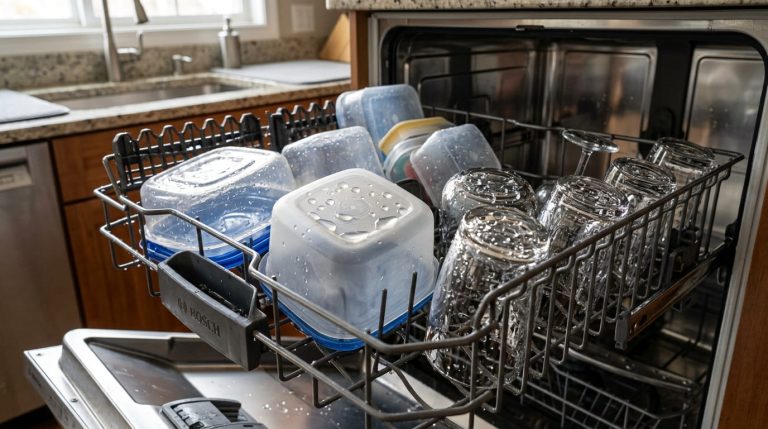
When your dishwasher is not cleaning top rack dishes but the bottom rack comes out spotless, the problem is almost always water delivery to the upper spray arm. Clogged spray holes, a cracked feed tube, a blocked filter, a failed diverter valve, or inlet water below 120 degrees Fahrenheit are the five causes behind most of these calls.
Pulling out cloudy glasses while the plates below look perfect is a specific failure pattern, and it points to a specific set of parts. The bottom rack is fed directly by the lower spray arm sitting right above the pump. The top rack depends on water traveling up a feed tube along the back wall before it reaches the upper spray arm. Anything that weakens that trip shows up as a dishwasher not cleaning top rack items while everything below stays clean.
Here is how the technicians at A Plus Appliance Repair narrow down a dishwasher not cleaning top rack loads, what you can check yourself in twenty minutes, and when the repair needs tools and a meter.
How the Top Rack Actually Gets Water
Understanding the water path makes the diagnosis obvious.
The circulation pump pushes water out in two directions. One path feeds the lower spray arm. The second feeds a vertical tube that carries water up to the upper spray arm and, on many models, to a third arm under the top of the tub. Most modern machines use a diverter valve to alternate between the two paths instead of running both at full pressure at once.
So the top rack is served last, at lower pressure, through the longest path. It suffers first when water volume, pressure, or temperature drops even slightly.
| What you see | Most likely cause |
|---|---|
| Top rack dirty, bottom rack clean | Clogged upper spray arm or blocked feed tube |
| Upper spray arm not working at all, no spin | Diverter valve failure or detached tube |
| Both racks poorly cleaned, film on everything | Low inlet temperature, hard water scale, clogged filter |
| Top rack wet and gritty, food redeposited | Filter packed or drain restriction |
7 Causes of a Dishwasher Not Cleaning Top Rack Dishes
1. Clogged upper spray arm jets
Each hole in the spray arm is small, and food particles, seeds, and hard water scale plug them fast. Pull the upper arm off, hold it to a light, and look through every hole. Clear blockages with a toothpick or a straightened paper clip, then flush the arm under a tap. If water runs freely from every jet, the arm is fine.
2. A cracked or disconnected feed tube
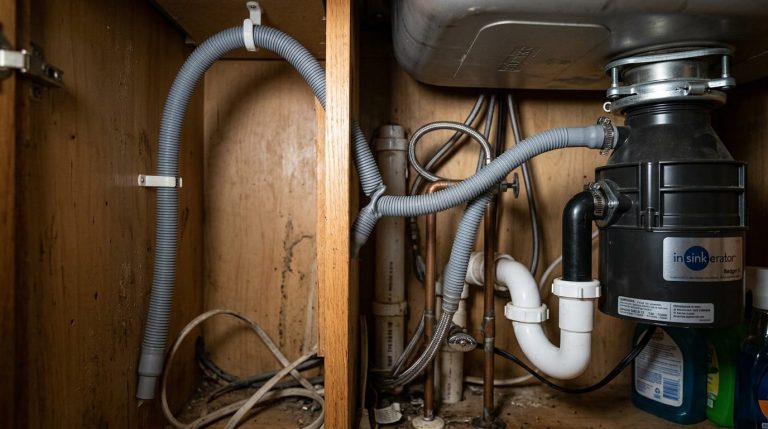
That vertical supply tube is plastic, and it flexes every time you slide the rack in and out. When it cracks or pops loose at the coupling, water dumps into the tub instead of climbing to the arm. It is the most common finding when a customer reports the upper spray arm not working with no spin at all. Run the machine for two minutes, open the door, and look for water shooting sideways from the back wall.
3. Failed diverter valve or motor
The diverter switches flow between the upper and lower arms. When the diverter motor fails or the valve sticks in the lower position, the bottom rack gets every drop and the top rack gets none. Some machines log an error code for this. It is the classic mechanical reason for a dishwasher not cleaning top rack dishes, and diagnosis requires testing the motor, which is where A Plus Appliance Repair usually gets called in.
4. A dirty filter or clogged sump
Most machines built after 2010 use a manual filter instead of a food grinder, and manufacturers generally recommend cleaning it monthly. When it packs with debris the pump starves, pressure drops, and the longest water path loses out first. Twist out the cylindrical filter, rinse it under hot water with a soft brush, and check the coarse screen beneath it.
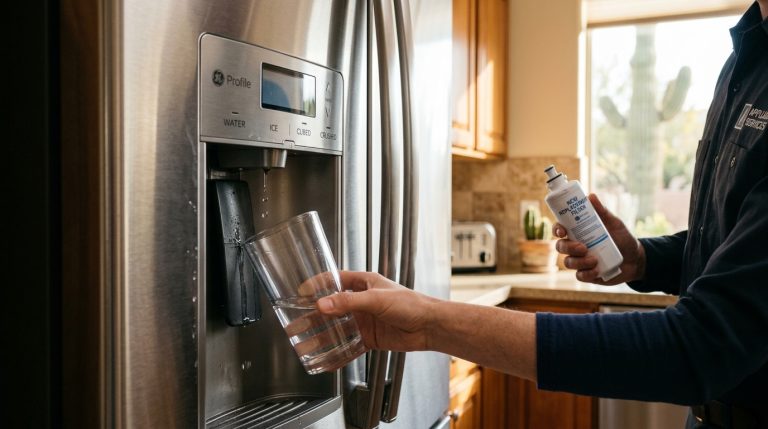
5. Water arriving below 120 degrees Fahrenheit
Detergent enzymes and the surfactants that lift grease are formulated to work at roughly 120 degrees Fahrenheit. Cooler water leaves a greasy film that shows worst on lightweight plastics and glasses, which live on the top rack. Run the kitchen faucet hot for a minute before starting a cycle. A water heater set below 120 can explain the whole problem by itself.
6. Hard water scale
Tucson tap water is hard, and dissolved calcium and magnesium build a chalky layer inside spray arms, on the heating element, and across glassware. Scale narrows the jets a little at a time, so the decline is gradual and easy to blame on detergent. Rinse aid plus a periodic citric acid cleaning cycle slows it down.
7. Overloading and blocked rotation
Tall items are the quiet culprit. A cutting board, a platter, or a pot handle sticking up from the lower rack stops the upper arm from spinning. Spin the arm by hand after you load. If it hits anything, the load is wrong, not the machine.
Checks You Can Run Yourself
Work through these in order before you book service.
- Empty the machine and spin the upper spray arm by hand. It should turn freely with no wobble.
- Remove the arm, clear every jet, and flush it out.
- Pull and rinse the filter and sump screen.
- Start a cycle, wait two minutes, open the door, and look for water spraying from the feed tube instead of the arm.
- Run hot water at the sink first and check your water heater setting.
- Switch to fresh powder or a sealed pod. Detergent loses strength once the box has been open a while.
- Add rinse aid and run an empty cycle with citric acid or a descaler.
If the dishwasher is not cleaning top rack dishes after all seven checks, the fault sits in the pump, diverter, or wiring, and that is a repair rather than a maintenance item.
Why This Fails More Often in Tucson
Two local conditions stack against dishwashers here, and both end with a dishwasher not cleaning top rack dishes properly. Hard water accelerates scale in every jet and along the heating element. Long plumbing runs and garage water heaters mean water sitting in the supply line has cooled by the time the dishwasher fills, especially on the first cycle of the day.
That combination is why so many households book expert dishwasher repair in Tucson for a symptom that looks like a broken machine but starts as a slow scale problem. A Plus Appliance Repair sees the same three parts over and over on these calls: the upper spray arm, the feed tube coupling, and the diverter motor.
Anyone shopping for expert dishwasher repair in Tucson should ask whether the technician tests water temperature at the inlet during diagnosis. Skipping that step leads to replaced parts that fix nothing.
When to Call A Plus Appliance Repair
Book service when you see any of the following.
- The upper spray arm not working even with the arm removed and the tube visible
- A diverter or motor error code on the display
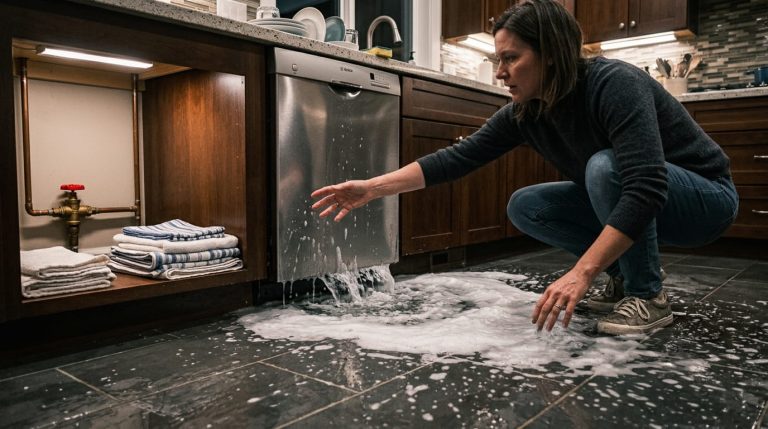
- Water pooling in the tub after the cycle drains
- A grinding or humming noise from the pump area
- No improvement after cleaning the arm, filter, and running a descale cycle
Those five point past maintenance and into parts, which is the point to book expert dishwasher repair in Tucson rather than keep experimenting.
A Plus Appliance Repair carries spray arms, feed tubes, diverter motors, and filters on the truck for every major brand, which keeps most of these repairs to one visit. For a same day diagnosis, book expert dishwasher repair in Tucson and have water temperature and pressure checked at the same time.
FAQ
Why is my dishwasher not cleaning top rack dishes but the bottom rack is fine?
The top rack is fed through a separate tube and spray arm. Clogged jets, a cracked feed tube, or a failed diverter valve cut water to the upper arm while the lower arm keeps working normally.
What does it mean when the upper spray arm is not working?
No spin usually means water is not reaching it. Check for a disconnected or split feed tube, an arm blocked by tall dishes, or a diverter stuck on the lower circuit.
Does water temperature affect only the top rack?
It shows there first. Plastics and glassware hold grease film at lower temperatures, so cool water hits the top rack hardest. Aim for 120 degrees Fahrenheit at the inlet.
How often should I clean the dishwasher filter?
Once a month for most households, more often if you rarely scrape plates. A packed filter drops pump pressure and starves the upper spray arm.
Is it worth repairing or should I replace the dishwasher?
Spray arms, feed tubes, and filters are inexpensive and worth fixing at almost any age. A failed circulation pump on a unit older than ten years is where replacement starts to make sense. A quote from expert dishwasher repair in Tucson tells you which side of that line you are on.
The Bottom Line
A dishwasher not cleaning top rack dishes is a water delivery problem, not a detergent mystery. Clear the jets, rinse the filter, verify the feed tube, and confirm your water reaches 120 degrees Fahrenheit. Those four checks solve most cases without any parts at all.
If the upper spray arm still refuses to spin, stop guessing and get it diagnosed. Call A Plus Appliance Repair for expert dishwasher repair in Tucson and have the diverter, pump, and inlet temperature tested properly.