Your refrigerator gives you warnings before it breaks down completely. The problem is that most homeowners either miss those warnings or assume the issue will fix itself. A strange noise becomes background sound. A small puddle gets wiped up and forgotten. A slightly warm milk carton gets pushed to the back of the shelf.
Ignoring these early signs does not make them go away. It makes them worse. What starts as a minor component failure can escalate into a full system breakdown that costs three or four times more to repair and puts hundreds of dollars worth of groceries at risk.
Knowing when to call for professional refrigerator repair saves you money, protects your food, and extends the life of your appliance. A Plus Appliance Repair helps Tucson homeowners recognize these warning signs and take action before a small problem becomes a kitchen emergency.
1. Your Food Is Not Staying Cold Enough
This is the most obvious sign and the one that demands the fastest response. If your milk feels lukewarm, your vegetables are wilting faster than usual, or your leftovers smell off after just one day in the fridge, the internal temperature has likely risen above the safe zone of 40 degrees Fahrenheit.
Several issues can cause this. A failing compressor cannot circulate refrigerant effectively. A broken evaporator fan stops distributing cold air from the freezer into the refrigerator compartment. Dirty condenser coils prevent the system from releasing heat properly. A malfunctioning thermostat or thermistor sends incorrect temperature readings to the control board, causing the compressor to cycle at the wrong intervals.
Whatever the cause, food that is not staying cold is food that is becoming unsafe. Do not wait to see if the temperature corrects itself. Contact A Plus Appliance Repair for a professional diagnostic before you lose an entire refrigerator full of groceries.
2. The Refrigerator Is Making Unusual Noises
Every refrigerator produces some sound during normal operation. The compressor hums, the fans whir, and the ice maker occasionally clicks and drops ice. These are routine sounds you stop noticing after a few days with a new unit.
The sounds that should concern you are different in character, volume, or timing.
Loud buzzing or humming that does not stop often indicates a compressor that is struggling to start or running under abnormal strain. The compressor may be losing its pumping capacity, or the start relay may be failing and preventing the compressor from engaging properly.
Clicking or ticking sounds followed by silence suggest that the compressor is attempting to start but failing. The start relay sends a pulse of current to get the compressor running, and when the relay is faulty, you hear the click of the attempt followed by the click of the overload protector shutting the circuit off. This cycle can repeat every few minutes.
Grinding or scraping noises point to a fan motor problem. The evaporator fan inside the freezer or the condenser fan at the bottom rear of the unit may have a worn bearing, a bent blade, or ice buildup interfering with the blade rotation.
Hissing or gurgling sounds can be normal if they are brief and occur during compressor cycles as refrigerant moves through the system. But prolonged or loud hissing may indicate a refrigerant leak, which requires immediate professional attention since refrigerant handling is regulated by the EPA and must be performed by certified technicians.
These noises are your refrigerator telling you something is wrong. Professional refrigerator repair from A Plus Appliance Repair identifies the exact source and resolves it before the noise becomes a complete failure.
3. Ice or Frost Is Building Up Inside the Freezer
A thin layer of frost on frozen food packages is normal. A thick wall of ice covering the back panel of the freezer, coating the evaporator coils, or blocking the air vents between compartments is not.
Excessive frost buildup almost always points to a defrost system failure. Modern frost-free refrigerators use an automatic defrost cycle that activates a heating element on the evaporator coils at regular intervals to melt any accumulated frost. When the defrost heater, defrost thermostat, or defrost timer/control board fails, that cycle stops and ice accumulates unchecked.
The consequences go beyond a frosty freezer. Ice on the evaporator coils blocks airflow, which means cold air cannot circulate to either compartment. The compressor runs longer trying to compensate, driving up your electric bill and accelerating compressor wear. Eventually, both the freezer and refrigerator sections lose proper temperature control.
If you notice ice building up on the back wall of your freezer or around the freezer vents, schedule a repair with A Plus Appliance Repair before the ice reaches a point where both compartments are affected.
4. Water Is Pooling Inside or Under the Refrigerator
Finding water inside the crisper drawers, on the bottom shelf of the refrigerator, or pooling on the floor beneath the unit is a sign that something in the drainage or water supply system has failed.
A clogged defrost drain is the most common cause of water inside the refrigerator. As the defrost cycle melts frost from the evaporator coils, the water is supposed to flow down a drain tube into a pan beneath the unit where it evaporates. When food particles, ice, or mineral deposits block that drain, water backs up into the freezer floor and eventually drips into the refrigerator compartment below.
A cracked or overflowing drain pan allows water to leak onto the floor. The drain pan sits beneath the compressor at the bottom of the refrigerator and relies on compressor heat to evaporate the collected water. If the pan is cracked, misaligned, or if the refrigerator is producing more condensation than the pan can handle, water ends up on your kitchen floor.
A leaking water inlet valve or loose water line connection can produce a steady drip that accumulates beneath or behind the unit. This is more common in refrigerators with ice makers and water dispensers.
Water damage to kitchen flooring, cabinetry, and subflooring can become extremely expensive if the leak continues unaddressed. A Plus Appliance Repair technicians trace the water to its source and fix the problem during the same visit in most cases.
5. The Refrigerator Is Running Constantly Without Cycling Off
A healthy refrigerator cycles on and off throughout the day. The compressor runs until the interior reaches the target temperature, then shuts off until the temperature rises enough to trigger another cycle. Depending on the ambient temperature, door openings, and food load, a typical refrigerator runs about 80 percent of the time in hot weather and less during cooler months.
A refrigerator that never stops running is working harder than it should, and something is preventing it from reaching its target temperature.
Worn door gaskets are a leading cause. When the rubber seal around the door deteriorates, warm air continuously leaks into the compartment. The compressor runs nonstop trying to overcome the constant influx of heat but can never quite get ahead of it.
Dirty condenser coils covered in dust, pet hair, and kitchen grease cannot dissipate heat efficiently. The compressor runs longer because the refrigerant is not cooling down adequately in the condenser before cycling back to the evaporator.
A thermostat stuck in the “on” position keeps sending a cooling demand signal to the compressor regardless of the actual interior temperature.
Low refrigerant charge from a slow leak means the system does not have enough cooling capacity to reach the set temperature, so the compressor never gets the signal to shut off.
Continuous running drives up electricity costs significantly and shortens compressor life. If your refrigerator sounds like it has not taken a break in days, it needs professional refrigerator repair immediately.
6. The Exterior Feels Unusually Hot
It is normal for the sides or back of a refrigerator to feel warm because the condenser coils release heat as part of the cooling process. However, if the exterior feels hot to the point of discomfort or if you notice the area around the refrigerator warming up your kitchen noticeably, something is wrong.
Excessive heat usually indicates that the condenser is overworking. Dirty coils, a failed condenser fan, or a refrigerant issue can all cause the condenser to run hotter than designed. In Tucson, where kitchen ambient temperatures are already elevated during summer, this additional heat output signals a system under serious stress.
A Plus Appliance Repair technicians check condenser coil condition, fan operation, and refrigerant system health when homeowners report an excessively hot refrigerator exterior.
7. The Ice Maker Has Stopped Producing Ice or Produces Odd Ice
A functioning ice maker depends on a clean water supply, correct water pressure, a properly operating water inlet valve, and freezer temperatures at or below 0 degrees Fahrenheit. When any of these conditions change, ice production suffers.
No ice at all could mean the water inlet valve has failed, the water supply line is frozen, or the ice maker assembly itself has malfunctioned.
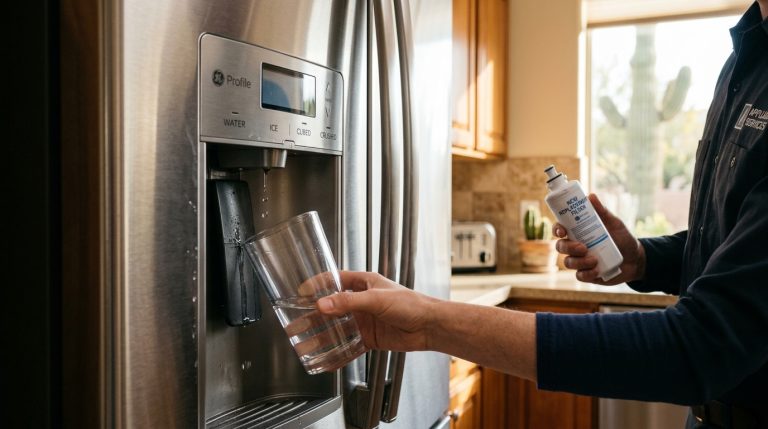
Small, cloudy, or hollow ice cubes typically indicate low water pressure or a water filter that is overdue for replacement. The ice maker is not receiving enough water to fill the mold completely.
Ice with an unusual taste or odor points to a water filter issue or contamination in the water supply line. Replacing the filter on the manufacturer’s recommended schedule (usually every six months) prevents most taste and odor problems.
While an ice maker failure may not feel as urgent as a cooling problem, it can be an early indicator of a temperature or water system issue that will affect other parts of the refrigerator if left unaddressed.
8. Your Electric Bill Has Increased Without Explanation
A refrigerator that is working harder than it should consumes more electricity. If your energy bill has climbed without a change in usage patterns, season, or rate, your refrigerator may be the cause.
Compressor issues, dirty coils, failing fans, and worn gaskets all force the refrigerator to use more energy to maintain the same temperatures. In some cases, a malfunctioning refrigerator can add $30 to $50 or more per month to your electricity bill compared to normal operation.
A professional diagnostic from A Plus Appliance Repair identifies the inefficiency and resolves it, often paying for itself in energy savings within a few months.
9. The Refrigerator Trips the Circuit Breaker
A refrigerator that repeatedly trips its circuit breaker is signaling an electrical problem that could be a safety hazard. Possible causes include a compressor drawing excessive current due to internal damage, a short circuit in the wiring harness, a failing defrost heater creating a ground fault, or a deteriorating power cord.
Do not simply reset the breaker and continue using the refrigerator. Repeated tripping indicates a condition that could potentially lead to overheating or other electrical problems. Call a professional technician to inspect the electrical components before resuming use.
10. There Is a Bad Smell You Cannot Eliminate
If you have cleaned the interior thoroughly, removed all expired food, and the smell persists, the odor may be coming from a component rather than from food.
A burned smell can indicate an overheating compressor, a failing fan motor, or a wiring issue. This requires immediate professional attention.
A chemical or sweet smell may suggest a refrigerant leak, particularly in older units that use different refrigerant types. Refrigerant leaks should only be handled by EPA-certified technicians.
A persistent musty or mildew smell even after cleaning may indicate mold growth in the drain pan, behind the unit, or inside the drain tube system. A technician can access and clean these hidden areas that are difficult to reach during normal kitchen cleaning.
When in Doubt, Call a Professional
Not every unusual behavior requires a repair call, but the signs listed above consistently indicate problems that worsen with time. The cost of a diagnostic visit from A Plus Appliance Repair is a small investment compared to the cost of a full system failure, spoiled groceries, water damage to your kitchen, or a premature refrigerator replacement.
A Plus Appliance Repair serves homeowners across the Tucson metro area with fast scheduling, accurate diagnostics, transparent pricing, and repairs that last. If your refrigerator is showing any of these warning signs, do not wait for the problem to announce itself with a complete breakdown.
Frequently Asked Questions
How do I know if my refrigerator problem is serious enough to call a repair technician?
If you notice any of the signs discussed above, especially temperature changes, water leaks, constant running, or unusual noises, the problem is worth a professional evaluation. A Plus Appliance Repair provides a clear diagnostic so you can make an informed decision.
Can I troubleshoot my refrigerator before calling A Plus Appliance Repair?
You can check a few basics like making sure the power cord is fully plugged in, the thermostat is set correctly, the condenser coils are not visibly caked with dust, and the door gaskets are seating properly. If these checks do not resolve the issue, professional diagnosis is the next step.
How quickly can A Plus Appliance Repair respond if I notice warning signs?
A Plus Appliance Repair offers same-day and next-day appointments in the Tucson area. Calls involving temperature failures or water leaks are prioritized to minimize food loss and property damage.
Will ignoring a small refrigerator problem make it more expensive later?
In almost every case, yes. A small component failure that costs under $200 to fix today can cascade into a compressor replacement or full system failure costing $500 or more if left unaddressed for weeks or months.
Does A Plus Appliance Repair service all refrigerator brands?
Yes. A Plus Appliance Repair works on all major brands including Whirlpool, Samsung, LG, GE, Frigidaire, KitchenAid, Maytag, Bosch, Sub-Zero, Viking, and many others across the Tucson metropolitan area.